English gardens are among the most popular around the world. Their ability to adapt to many different building facades and probably all imaginable spaces gives them a clear advantage over other types of gardens. The history of the English method of gardening can be traced back to the 16th century, when the first assumptions deliberately created in this style began to arise, by opposition to the then very expansive French gardens. Since then – for half a thousand years! – the style and design of English gardens at the same time changed beyond recognition and … remained the same in spirit. Combining what is nonchalantly natural and “wild” with what is refined and cultured was a feature that has ensured this style’s popularity for centuries. And what were the other factors?
How often do we run away to the nooks where no one has been before? Nobody cut down the trees, nobody threw away rubbish and nobody built concrete walls? Man in his pursuit of perfection never reaches nature, and although he wants to tame it, he still follows his unchanging path, hiding in the innermost corners hiding the world so much opposite to ours …
Attempts to imitate nature were most reflected in the English gardens, and their whole essence was limited to making the garden look like a natural landscape. Dating back to the 17th century, we encounter mines of examples of English garden assumptions.
Balance between the beds and the lawn
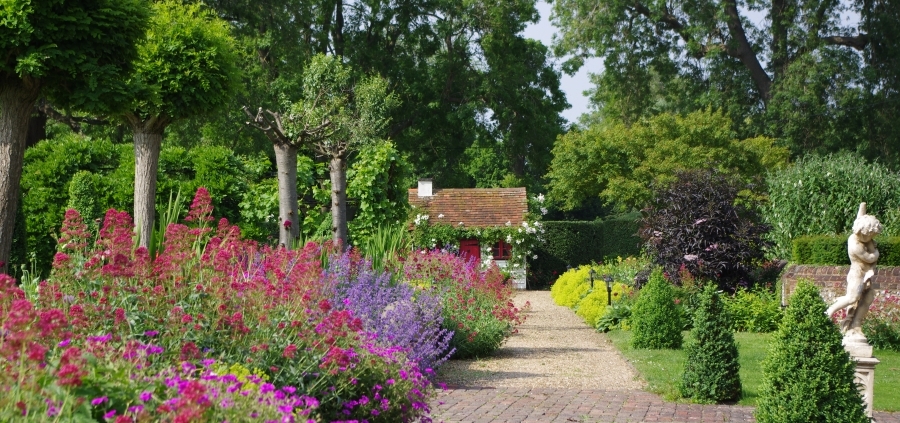
Probably no one doubts that in the case of an English garden they are plants – and not, as in the Japanese garden or some variants of the European conceptual garden, ornaments or inanimate forms – are by far the most important element. A distinctive feature is their variety and diversity, allowing you to give the garden a more natural look without losing the hard to describe, but easily perceptible atmosphere of something that has been changed and carefully cared for by man. Particular emphasis is placed on the range of colors of plants, which should be harmonious and thought out, and on how to maintain the lawn: it is not intended to dominate the assumptions, but to emphasize its other elements and bind them together. It is worth emphasizing that in the English garden there is room for all types of plants: also for vegetables and fruits.
What goes up and overflows
Most gardeners like creepers, but those English have a special weakness for them. It would be difficult to find an English garden without them. Sentiment to vines can be due to the general tendency of the English garden to make concessions for luxuriance and abundance: just like vines wrap around trunks, facades, trellises and gazebos, creating a kind of allowance, so the plants collected in discounts do not stick to strictly designated here them borders, flowing through them with a colorful wave – and even in the most formal scenes of the style!
Sophisticated shapes
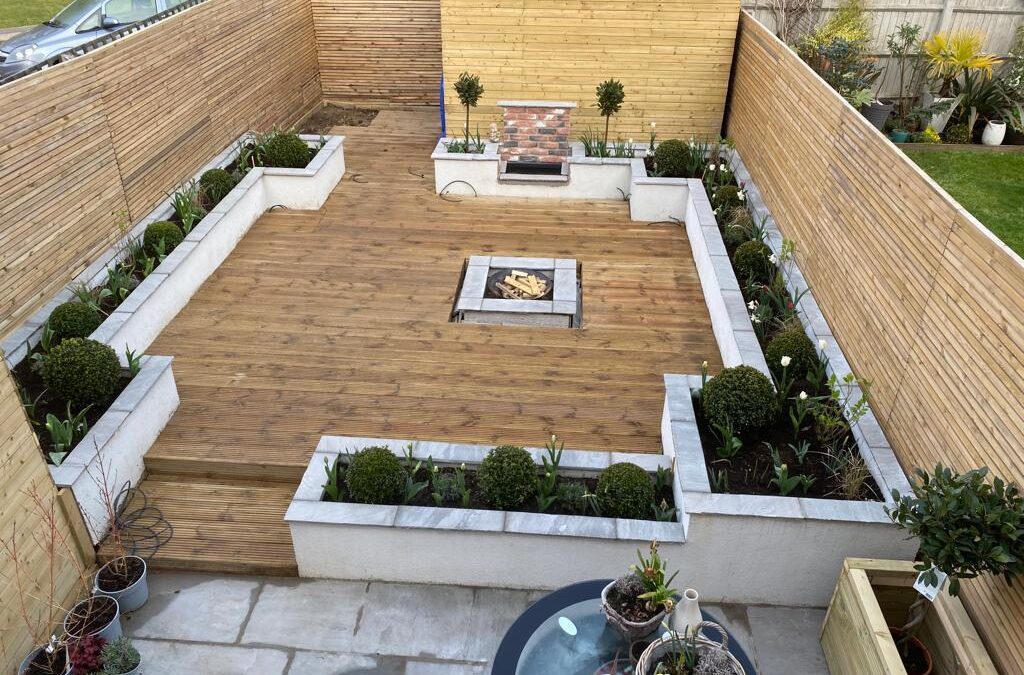
The English garden may seem wild, but it is really a set of carefully selected shapes, both in the formal and informal version. However, while in the former the emphasis is mainly on straight lines, angular geometrical figures and symmetry, the latter prefer a looser, soft approach: assumptions on the plan of circles and ovals and curvature. The first type may seem a bit stiff, but it is to be: it is the style preferred by the aristocracy and most often found nearby palaces. The informal English gardens, in turn, will fit just as well as a villa on the outskirts of the city, as well as a country house.
How to describe an English garden?
Here are the most important elements and rules for creating English gardens:
- beauty of natural natural forms
- irregular clusters of trees and shrubs, flower beds and groves (instead of commonly used clipped lines and geometric plantings)
- trees in natural form, freely growing
- the presence of large lawns and meadows
- creating and highlighting uneven terrain
- the use of natural sources, rivers and lakes with irregular outlines
- the roads run along curved lines, revealing picturesque views and connecting individual parts of the garden
- the whole garden plan is irregular, free and asymmetrical
- English gardens are secret and “wild” gardens
- the garden can go into a park and then connect fully with the landscape
- sculptures set up not accidentally have their own character, often set directly on the ground, without a pedestal